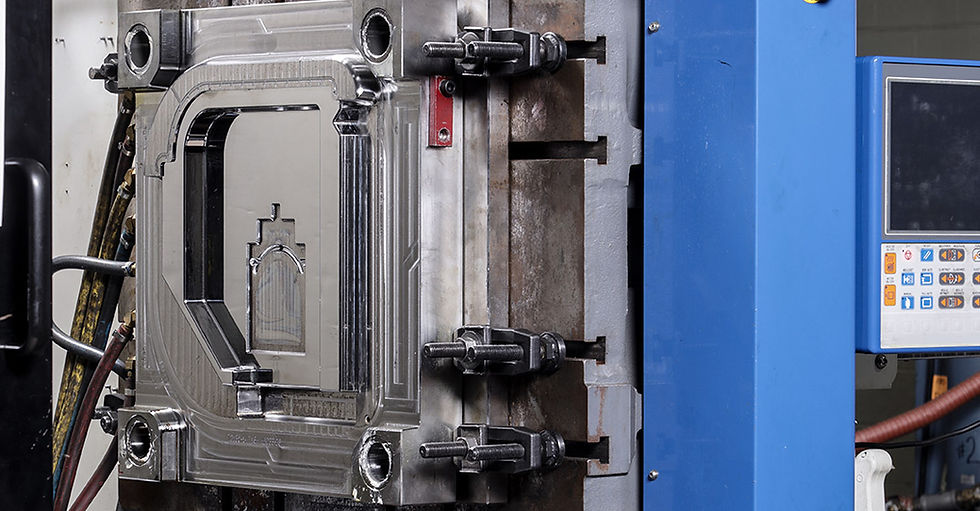
High-Precision Tooling for Injection Moulding

In the plastic manufacturing industry, your most significant financial commitment isn't just the machine on the floor—it’s the tooling for injection moulding. At Moraine Plastics, we don’t view a mould as just a hollow block of steel; it is a complex industrial machine. It is the core operational system that determines whether your project succeeds or fails.
A properly engineered tool ensures that the 10,000th part is an exact replica of the first. For engineers and procurement teams, understanding the intersection of scientific moulding and tool design is the only way to reduce waste, shorten cycle times, and guarantee market success.
Why Tooling for Injection Moulding is the "Brain" of the Operation
While most industry discussions focus on clamping force or tonnage, those are simply the "muscle." The tooling is the "brain." If your tool isn't designed to withstand the thermal and mechanical rigors of a high-speed cycle, the run will fail before the first pellet of resin melts.
"A cheap tool is the most expensive thing a manufacturer will ever buy," says Gerry Ford, Owner of Moraine Plastics. "You might save ten thousand dollars on the front end, but you’ll pay for it every day in scrap rates, downtime, and missed deliveries. We build tools for a million cycles, not a thousand."
Scientific Moulding and Thermal Management
The difference between a "mould" and high-performance injection moulding tooling lies in thermal management. We utilize Scientific Moulding principles to ensure the plastic maintains its integrity. This requires:
Conformal Cooling: Placing cooling channels precisely to prevent "dead zones."
Uniform Shrinkage: Preventing warped parts and inconsistent dimensions.
Complexity and the "Tolerance Trap"
The "tolerance trap" is a common hurdle when producing miniature parts or complex medical device enclosures. A tool that bends under pressure cannot maintain a tolerance of ±0.001 inch.
Using Mold Flow Analysis, we predict resin behavior through thin walls and undercuts. If we see a pressure spike, we don't just "turn up the heat"—we re-engineer the gate location or the steel grade to keep the tool structure stable and the dimensions precise.
"Smart" Moulds: Sensors and Repeatability
Moraine Plastics has moved away from "blind" operations. Modern tooling for injection moulding now acts as a nervous system, utilizing:
In-cavity pressure sensors
Thermal sensors
Real-time data benchmarking
In the past, technicians "listened" for failures. Today, we use a "master curve." If a sensor detects even a 2% drop in cavity pressure—often a sign of shifting resin viscosity—the system flags it immediately. This provides a level of repeatability that manual inspection simply cannot match.
Engineering for the Long Game: Material Selection
Selecting the right steel is a strategic decision. While P20 steel is common, it will be destroyed by abrasive materials like glass-filled nylon. We prioritize H13 and Stainless 420 to protect against the corrosive effects of high-performance resins.
Through Design for Manufacturing (DFM), we simplify the complex. By refining draft angles and parting lines, we ensure the tool is easy to service and the parts release flawlessly.
At Moraine Plastics, we don't just sell moulds—we deliver consistent, high-output production systems. In this industry, your imagination should be the only variable—never your part quality. Don't let your critical project be hampered by an inferior mould. Contact Moraine Plastics to start discussing your custom injection molding tooling needs today.